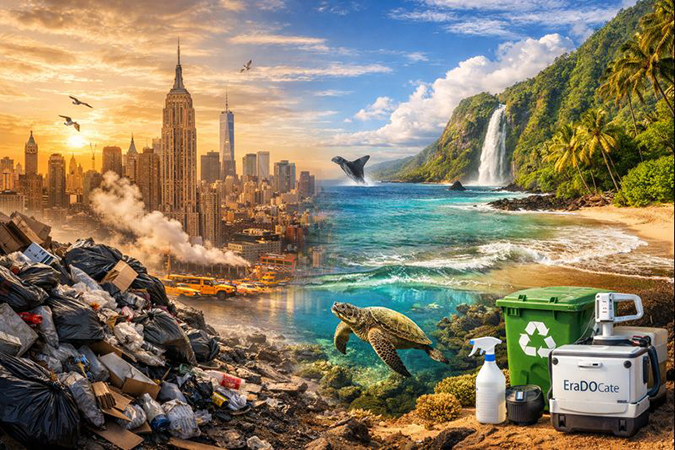
A Tale of Two Islands argues that New York City and Maui, though visually opposite, share an island reality: finite space and finite tolerance for waste. When an island cannot safely process what it imports, consumes, and discards, risk accumulates like a body that cannot clear toxins—showing up as airway irritation and asthma pressures, skin and eye inflammation for workers, corrosion, ecological strain, pests, outbreaks, and eroding trust.
The blog contrasts New York’s density-and-throughput challenge with Maui’s ecosystem fragility, then reframes disinfection as precision: control pathogens without harming the host or the habitat. It critiques reliance on quats and bleach not as “ineffective,” but as a commodity logic that ignores indoor air, residues, maintenance costs, and downstream environmental load. It highlights qualitative evidence in nurses linking disinfectant exposure with COPD and cardiovascular risk, reinforcing exposure-reduction without miracle claims.
The piece then targets the incentive problem—procurement that rewards cheapest gallons and entrenches incumbency—before advancing a solutions package: a Two-Island Cleanliness Compact with outcome-based standards, transparent metrics, and pilots; plus Sanitation Impact Bonds repaid by measured reductions in injuries, closures, and corrosion costs. Maui’s tourism-linked stewardship and New York’s building performance credits turn cleanliness into civic brand equity and invites immediate participation.
Islands operate like closed-loop organisms. In medicine, when an organ’s clearance system fails—when the lymphatics don’t drain, when the kidneys can’t filter—swelling and toxicity become systemic. The island analog is blunt: if an island cannot safely process what it imports, consumes, and discards, it accumulates risk. The “symptoms” show up as asthma in children, irritated skin in workers, corrosion of buildings, algae blooms, reef stress, rodent pressure, infectious outbreaks in congregate settings, and the slow erosion of trust that “someone is in charge.”
New York City’s constraint is density and throughput: millions of people, constant movement, constant contamination potential, and a sanitation system that must function as reliably as a heartbeat. Maui’s constraint is scale and fragility: a smaller population, but an ecosystem where small perturbations magnify—because reefs, aquifers, and shorelines are not forgiving wastebaskets.
People come to New York because it is an amplifier. Careers accelerate. Networks compound. Food, culture, and specialized healthcare become accessible in a way few geographies can match. The cost is intensity—financial, psychological, and environmental. New York’s myth is not comfort; it is initiation. “If you can make it here, you can make it anywhere” is not a slogan—it is a psychological contract with pressure.
People come to Maui for the opposite reason: to be de-pressurized. Maui is not merely scenic; it is restorative. Many arrive after personal disruption—illness, divorce, burnout, grief—and some quite literally rename themselves, shedding an old identity the way a snake sheds skin. This is not escapism; it is reinvention. But reinvention only holds if the environment supports health rather than silently undermining it. In both places, residents are buying the same hidden product: a livable future. They differ only in scenery.
In clinical language, the goal is not maximal destruction; it is targeted control with minimal collateral damage. A hospital does not sterilize the world; it manages risk intelligently. Yet conventional cleaning in many institutions still leans heavily on legacy chemistries—quaternary ammonium compounds (“quats”) and chlorine-based bleach—because they are cheap, familiar, and easy to scale.
The problem is not that these chemicals “never work.” The problem is that the business logic of commodity disinfection often ignores externalities: indoor air quality, skin and airway irritation, chemical residues, corrosion, and ecological load. In a dense city, those costs concentrate indoors—in apartments, schools, subways, offices. On an island like Maui, those costs can travel outward—into wastewater systems, into nearshore environments, and into the delicate chemistry that reefs and fisheries depend on.
“Elevated disinfection” should mean something more rigorous than “stronger chemicals.” It should mean higher performance per unit of harm:
This is where eco-oriented platforms—like the kind pioneered by companies such as EraDOCate (hard-surface disinfection coupled with water-purification ambitions)—become strategically relevant. Not as a marketing story, but as a systems upgrade: new methods, new metrics, and new accountability.
The most honest way to talk about health here is to avoid magic promises and focus on exposure pathways.
Respiratory burden: Repeated exposure to certain disinfectants and cleaning agents has been associated in the literature with respiratory health concerns in healthcare settings, including asthma-related findings—particularly for workers with repeated exposure. This is precisely why exposure-reduction strategies compatible with infection control matter.
COPD signal (qualitative): In a large longitudinal cohort of U.S. nurses, regular use of chemical disinfectants was associated with a higher subsequent risk of developing chronic obstructive pulmonary disease (COPD). This is observational evidence—not a guarantee of causality—but it reinforces a commonsense policy aim: reduce avoidable exposures while preserving infection-control performance.
Cardiovascular signal (qualitative): In a large prospective cohort of U.S. nurses, occupational exposure to disinfectants in real-world healthcare settings was associated with a higher subsequent risk of incident cardiovascular disease (including coronary heart disease and stroke). This too is observational evidence—not a causal claim—but it strengthens the case for minimizing unnecessary chemical exposure when comparable performance can be achieved with safer protocols.
Dermal and ocular burden: Cleaning staff and caregivers often pay the hidden price—contact dermatitis, eye irritation, and chronic inflammation from repeated chemical contact.
Microbial ecology and resistance pressures: Overuse and misuse of disinfectants can be counterproductive—driving sloppy practices (“spray and pray”) instead of disciplined protocols (contact time, correct dilution, surface compatibility).
Toxicological prudence: Certain chemical classes and byproducts raise legitimate toxicology questions. It is not responsible to promise that changing cleaners will “decrease cancer rates” as a guarantee. It is responsible to say this: reducing unnecessary exposure to potentially hazardous compounds is a rational public health strategy, particularly when safer high-performance alternatives exist.
Large brands—Ecolab, Diversey, Clorox, Lysol, 3M and peers—are not villains in capes. They are corporations optimized for scale, procurement simplicity, and repeat purchasing. Their natural incentive is to defend low-cost, high-volume chemical paradigms because those paradigms sell well into institutional contracts.
The deeper critique is philosophical and economic: when procurement rewards the lowest unit price per gallon, the system selects for chemical intensity and ignores downstream costs paid in asthma, corrosion, wastewater load, worker injury, and environmental damage. In medicine we call that treating the symptom while feeding the disease.
This is also where policy overreach hides in plain sight: not always as a dramatic law, but as a slow drift into “compliance theater”—rules and contracts that appear to protect the public while quietly privileging incumbency, suppressing innovation, and insulating decision-makers from scrutiny. It becomes easier to mandate what is familiar than to measure what is true.
The Financial Policy Council’s (FPC’s) position is direct: if public money is buying “public health,” then the public deserves public visibility—transparent standards, transparent procurement, and transparent performance.
New York’s waste challenge is magnitude and logistics: millions of daily decisions become mountains of trash, and the city must move those mountains without collapsing into them. Maui’s waste challenge is geographic: limited landfill capacity, shipping constraints, and an environment where mismanaged waste shows up quickly—on beaches, in streams, in reefs, and in community morale.
Both places suffer from the same illusion: that “throwing away” is a real action. It is not. It is displacement.
Here is the uncommon idea worth adopting: waste is a moral biography. Every piece of trash is a receipt of a choice—manufactured, purchased, consumed, discarded. Islands expose biography because they lack hiding places. If New York is the empire of consumption, Maui is the tribunal of consequence.
The FPC exists to defend the conditions that make self-governance possible: transparency, accountability, competition, and citizen agency. In sanitation, that translates into concrete work—not slogans:
A serious sanitation upgrade cannot rely on guilt. It must be financed like infrastructure and marketed like civic pride.
Create an FPC-led “Two-Island Cleanliness Compact.” A public-private initiative that sets performance standards: reduced chemical toxicity burden, measured indoor air improvements in pilot buildings, worker safety metrics, and wastewater compatibility criteria.
Launch “Sanitation Impact Bonds.” Investors fund the transition (training, equipment, product substitution, monitoring). Repayment is tied to measurable outcomes: reduced worker injury claims, reduced absenteeism, fewer sanitation-related closures, improved satisfaction scores, and reduced corrosion/maintenance costs. This is not charity; it is disciplined ROI.
Tourism-linked stewardship on Maui, density-linked stewardship in New York.
Make sanitation a prestige signal, not a cost center. In marketing terms: turn cleanliness into brand equity. New York’s brand is excellence under pressure. Maui’s brand is health in harmony with nature. Elevated disinfection becomes the shared proof that each place protects what it claims to be.
Most people think sanitation is about germs. It is not.
Sanitation is about what a society is willing to see.
When the air stings and the label is hidden, when the contract is sealed and the costs are externalized, when the media sells panic but not measurement, a new kind of pollution has already occurred: informational contamination. And that contamination does not attack the lungs first—it attacks the citizen.
A free people cannot remain free inside a fog. Liberty requires clean air, yes—but it also requires clean disclosure, clean incentives, and clean accountability. In that sense, “elevated disinfection” is not merely a better way to wipe a surface. It is a better way to run a Republic: expose what is being sprayed, expose who is paid, expose what is measured, and let the truth of outcomes—not the comfort of incumbency—decide what survives.
New York and Maui are not merely locations; they are civilizational statements. One says: human ambition can concentrate without collapsing. The other says: human life can be refined without becoming soft. The Financial Policy Council exists for the moment when those statements are tested—not in speeches, but in systems.
And here is the twist: the real “two islands” are not New York and Maui. The two islands are ignorance and agency. In one, we accept what we are told and pay what we are billed. In the other, we insist on seeing—and once we see, we cannot unsee. Choose the island that makes you larger.
Notes (for traceable sourcing) [1] Longitudinal analysis of disinfectant exposures and incident asthma in U.S. nurses (context for respiratory burden framing).
[2] Chemical disinfectant use and incident COPD risk in nurses (observational association).
[3] Disinfectant exposure and incident cardiovascular disease risk in Nurses’ Health Study II (observational association).
[4] CDC/NIOSH hazard communication emphasis for disinfectant ingredients and exposure controls.
[5] Evidence that quaternary ammonium disinfectant sprays can generate airborne exposures during typical cleaning tasks (context for “right-to-know” framing).
Disclaimer: This article discusses certain companies and their products or services as potential solutions. These mentions are for illustrative purposes only and should not be interpreted as endorsements or investment recommendations. All investment strategies carry inherent risks, and it is imperative that readers conduct their own independent research and seek advice from qualified investment professionals tailored to their specific financial circumstances before making any investment decisions.
The content provided here does not constitute personalized investment advice. Decisions to invest or engage with any securities or financial products mentioned in this article should only be made after consulting with a qualified financial advisor, considering your investment objectives and risk tolerance. The author assumes no responsibility for any financial losses or other consequences resulting directly or indirectly from the use of the content of this article.
As with any financial decision, thorough investigation and caution are advised before making investment decisions.
How Reimbursement Architecture Shapes What Scales in American Medicine — and Why Regenerative Innovation Must Integrate, Not Bypass, the System By Martin Johns MD, Gregory...
 Martin C. Johns MD
How Modern Disinfection Became a Ritual of Harm—and How Science Is Beginning to Whisper the Truth By Martin Johns MD and Stanford Silverman I. The...
 Martin C. Johns MD
Reclaiming the American Economic Covenant – and the Financial Policy Council’s Mandate for Policy Accountability By Paul Mourino (Board Member, Financial Policy Council) Introduction: Davos,...
 Paul Mourino
We Extend Our Gratitude to Our Partners